Ablation Techniques
A variety of ablation techniques exist for many different purposes. Each can be used with their own benefits and limitations. Here, we briefly present three ablation techniques that are part of our active fields of research:
Microwave Ablation (MWA) represents a groundbreaking advancement in the clinical treatment of tumors, particularly those of a few centimeters in size. As a minimally invasive procedure, MWA offers significant benefits over traditional surgical interventions. One of its most compelling advantages is the reduced risk profile, coupled with a faster recovery time for patients [1]. This aspect is crucial in enhancing patient comfort and reducing the overall burden on healthcare systems. Additionally, it can be a viable alternative for patients who are not eligible for open surgery [2].
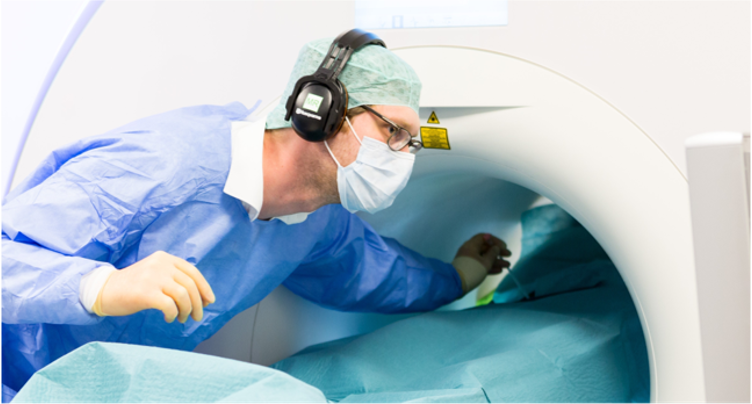
Moreover, the integration of MWA within Magnetic Resonance (MR) environments takes its efficacy to a new level. The MR-guided approach allows for real-time needle guidance and 3D thermometry. This capability is particularly advantageous when dealing with tumors that are challenging to access. By enabling precise targeting, MR-guided MWA ensures that treatments are not only effective but also exceptionally precise.
The real-time 3D thermometry feature of MR-guided MWA is a game-changer. It allows clinicians to monitor the temperature of the targeted area accurately, ensuring that the ablation is effective while preserving as much healthy tissue as possible. This balance is crucial for patient outcomes, as it minimizes potential side effects and maximizes the therapeutic effect of the ablation.
In summary, MR-guided MWA stands out as a minimally invasive, highly precise, and safe option for treating certain tumors. Its ability to provide real-time guidance and temperature monitoring ensures that treatments are not only effective but also tailored to preserve healthy tissue, thereby optimizing patient outcomes.
The real-time 3D thermometry feature of MR-guided MWA is a game-changer. It allows clinicians to monitor the temperature of the targeted area accurately, ensuring that the ablation is effective while preserving as much healthy tissue as possible. This balance is crucial for patient outcomes, as it minimizes potential side effects and maximizes the therapeutic effect of the ablation.
In summary, MR-guided MWA stands out as a minimally invasive, highly precise, and safe option for treating certain tumors. Its ability to provide real-time guidance and temperature monitoring ensures that treatments are not only effective but also tailored to preserve healthy tissue, thereby optimizing patient outcomes.
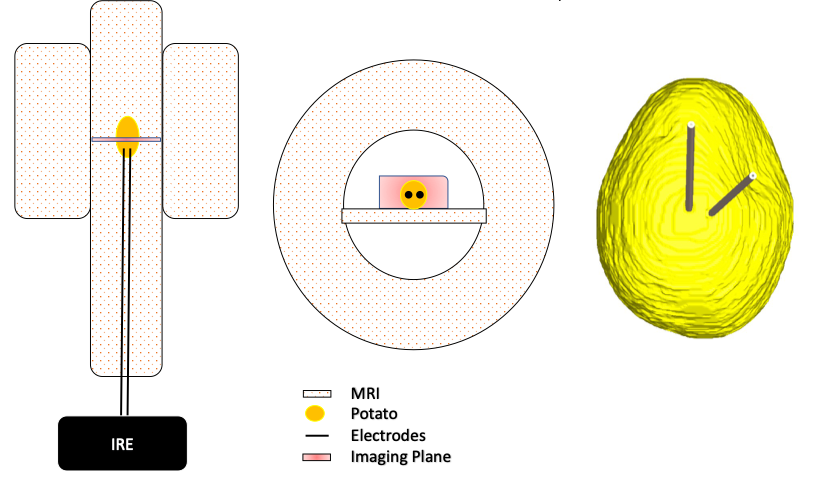
Irreversible Electroporation (IRE) is a non-thermal ablation technique that utilizes short electrical pulses to induce cell death in soft tissue. By changing the membrane potential, IRE creates tiny pores in the cell membrane, primarily through apoptosis. This minimally invasive and tissue-preserving method is particularly valuable in treating tumors in sensitive areas where surgical removal, such as near vital organs or major blood vessels, may be challenging or not feasible.
IRE has been successfully used in various cancer treatments, including liver, pancreatic, prostate, and kidney cancers [3][4]. It offers several advantages over other ablation modalities, such as sparing surrounding healthy tissue and critical structures, including blood vessels and nerves, while creating well-defined ablation zones. This selective targeting of cells with high electrical conductivity helps to minimize complications and improve patient outcomes, especially in combination with sparing the patient from side effects of thermally induced necrosis.
IRE is typically performed under image guidance, such as ultrasound (US) or computed tomography (CT), to position the electrodes accurately. Magnetic Resonance Imaging (MRI) can also guide electrode placement and potentially provide crucial information for intra-operative treatment monitoring. IRE represents a promising option in ablation therapies, offering precise and possibly less invasive treatment approaches for certain types of cancer.
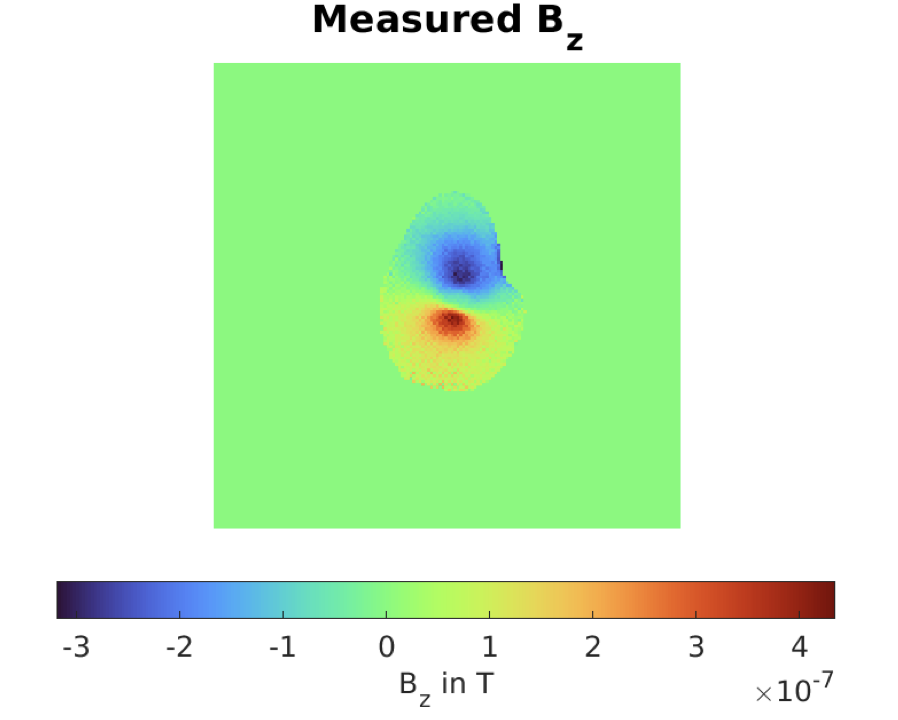
Cryoablation is a minimally invasive procedure and provides an alternative to heat-based procedures like microwave ablation in the treatment of tumors. In contrast to microwave ablation, tissue necrosis is caused by extremely low temperatures. Depending on the tumor size, one or more needles are inserted into the patient and cool down the tissue. Due to the analgetic nature of low temperatures, this procedure causes less pain to the patient than heat-based methods [6][7]. However, it comes with the trade-off that the treatment takes more time and is more costly.
Cryoablation can also be used under MR-guidance which provides an excellent contrast between frozen and non-frozen tissue. But since frozen tissue does not necessarily also mean necrotic tissue, the research of our group focuses on determining the actual temperature per voxel through the MRI measurement.
References
[1] Livraghi et al. Sustained complete response and complications rates after radiofrequency ablation of very early hepatocellular carcinoma in cirrhosis: is resection still the treatment of choice? Hepatology 47 (2008)
[2] Llovet and Bruix. Systematic review of randomized trials for unresectable hepatocellular carcinoma: chemoembolization improves survival. Hepatology 37 (2003)
[3] Savic et al. Irreversible Electroporation in Interventional Oncology: Where We Stand and Where We Go. RöFo – Fortschritte auf dem Gebiet der Röntgenstrahlen und der bildgebenden Verfahren 188 (2016): 735 – 745.
[4] Vailas et al. Irreversible electroporation and sarcomas: where do we stand? Journal of B.U.ON.: official journal of the Balkan Union of Oncology 24 4 (2019): 1354-1359.
[5] Belker et al. Treatment Monitoring of Irreversible Electroporation in a Potato Model with a two-shot CP/CPMG-RARE sequence and Spiral Sampling. ISMRM Proceedings (2024)
[6] Thacker et al. Palliation of painful metastatic disease involving bone with imaging-guided treatment: comparison of patients’ immediate response to radiofrequency ablation and cryoablation. AJR. American journal of roentgenology 197 2 (2011): 510-5.
[7] Allaf et al. Pain control requirements for percutaneous ablation of renal tumors: cryoablation versus radiofrequency ablation–initial observations. Radiology 237 1 (2005): 366-70.